
WLRH After NPR: The Audience Transition

Editor's Note: This post has been updated to reflect more accurate sourcing of Nielsen audience data. A subsequent post will provide additional context about how Nielsen ratings data is released and what these figures do and don't represent.
WLRH’s decision to drop NPR on October 1, 2025 is now beginning to show up in the ratings — and the early numbers reveal a station in transition.
In my previous post, I wrote about the impact on membership and development and how the Alabama Education Television Commission decided to drop NPR in the first place. (The Commission governs WLRH.)
Ratings data can quickly make your eyes glaze over. But I’m (hopefully!) breaking it down to best understand what is and what isn’t going on. WLRH receives data in the spring and fall each year. The Huntsville market uses Continuous Diary Measurement (CDM).
Here’s what that means in plain English: Because CDM averages three months at a time, any major programming change shows up slowly — and unevenly. Nielsen produces ratings every month, but WLRH only purchases two of those monthly reports each year:
June: the official Spring book = Apr–May–Jun (3-month rolling average)
December: the official Fall book = Oct–Nov–Dec (3-month rolling average)
WLRH posted a 2.0 audience share for the Dec (aka Fall) 2025 book.
This represents a significant decline from the Spring 2025 book (3.0 share), the last fully subscribed measurement before the format change. (Share = a station’s percentage of all radio listening in a given time period.)
(These figures are drawn from a public document presented at an Alabama Educational Television Commission board meeting.)
How the October Programming Change Fits In
Because CDM uses three‑month averages, the shift away from NPR shows up gradually. The Fall 2025 book (2.0 share) reflects a three-month rolling average that captures the transition in progress and not a clean read of the new format. That's because:
October 2025: Mostly pre‑change listening.
November 2025: A blend of old and new programming.
December 2025: Two full months of the new format.
This means the December 2025 number (aka Fall book, with its three-month rolling average) is a transition snapshot, not a final verdict. The first fully subscribed measurement of the new format will be the Spring 2026 book. That number will show whether the audience is stabilizing, growing, or shrinking under WLRH's new schedule.
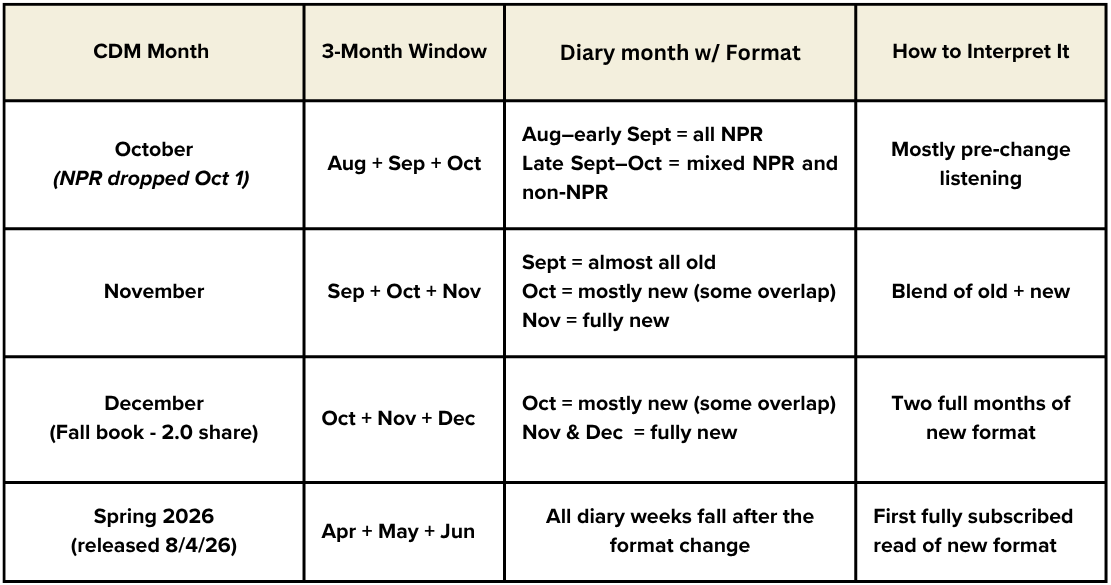
Note: Even though the programming changed on October 1, Nielsen diaries don’t follow calendar months. They follow 7‑day listening weeks, which include several days of September (with NPR programming) and several days of October (without NPR programming).
What a 2.0 Share Really Tells Us (and What It Doesn’t)
The latest ratings aren’t a judgment — they’re a bridge between two very different versions of WLRH. A 2.0 share in the Fall book can reflect::
The immediate audience loss from removing NPR
The early, unsettled phase of a new programming lineup
The data can’t tell us is the exact proportion of:
Listeners who left because NPR is gone vs…
Listeners who are still adjusting to the new schedule vs…
Listeners who haven’t discovered the new programming yet
But that doesn’t mean the NPR loss isn’t the dominant factor. It’s completely reasonable (and frankly expected) that a portion of the 2.0 isn’t measuring who’s listening — it’s measuring who stopped listening when NPR went away.
That’s not emotional, that’s strategic reality. Because in public radio, the brand is the product. Radio audiences don’t behave like “if you build it, they will come.” They behave like “if you remove what I came for, I leave.”
And in a diary market, that shows up fast.