
When Your Licensee Undercuts Your Business Model
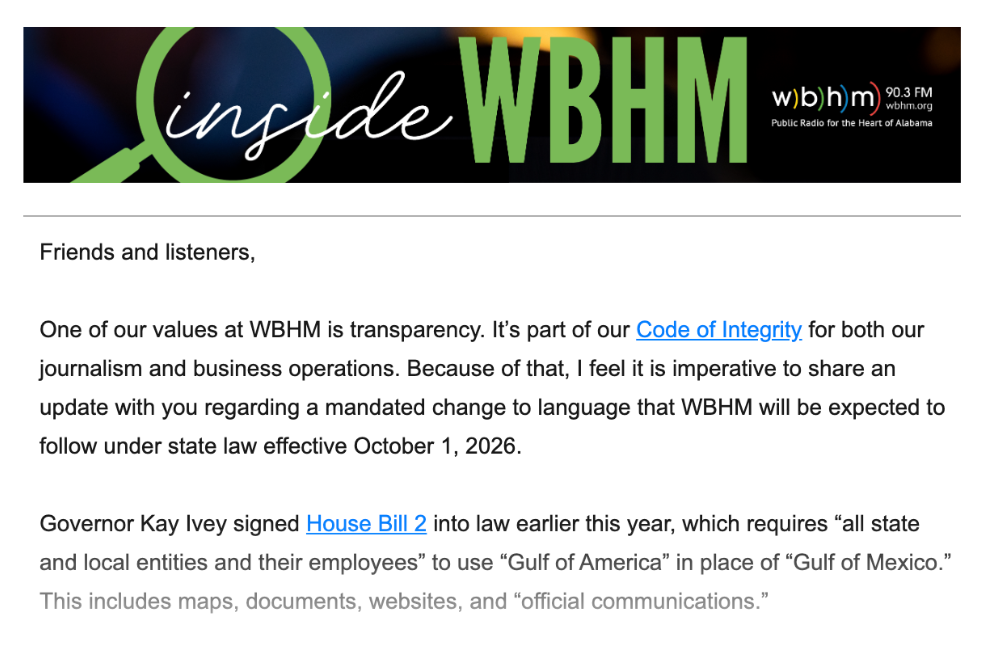
Click the image above to read the full text of Will Dahlberg’s September 25 letter to WBHM listeners (PDF).
Back around 2012, Alec Baldwin recorded a spot that turned on-air public radio fundraising on its ear. He threatened listeners into NOT donating! Yes you read correctly. With lines such as:
I've come here to your public radio station during your sad little pledge drive with a simple message: don't give. Let public radio sputter and die a slow, underfunded death... Help me destroy public radio. This pledge drive, do what most of your fellow listeners do…nothing.
It may sound counterintuitive, but this was must-hear radio. It was the complete opposite message of how stations would normally raise money on-air, and it grabbed your attention. The message got played a lot throughout the system for a while and the humor certainly got some listeners to give. In 2026, it’s not so funny anymore.
Let’s take a quick look back before we jump to the present. In the last several years, public radio news/talk stations made significant investments in local journalism, covering their community in ways commercial media couldn’t or wouldn’t do. Stations leaned into their local journalism and presented it alongside NPR’s national and international coverage. When it came to fundraising, stations rightly touted (and continue to tout) local, independent, trustworthy, fact-based journalism for everyone with no paywall. That independence isn't just an ethical commitment. It's what listeners are paying for.
Federal support of public broadcasting ended in July of 2025. One year later, stations are being forced to adapt to a new financial reality with layoffs, mergers, and consolidations. As difficult as this time period is, many public stations still produce meaningful journalism in communities of all sizes in spite of the fiscal and political pressure.
That pressure came to bear in my home city of Birmingham, Alabama, where the news staff of WBHM keeps producing serious, award-winning local journalism through much uncertainty. That work deserves better than what's happening to it now. The University of Alabama at Birmingham (UAB) holds WBHM's broadcast license, and on Friday, September 25, WBHM's then-General Manager Will Dahlberg told listeners in this message that the station's team will be expected to use "Gulf of America" in place of "Gulf of Mexico" starting October 1, under Alabama House Bill 2. Dahlberg wrote that UAB and University of Alabama System officials told him that every communication WBHM staff make in their role, broadcasts included, counts as "official communication" under the law.
(A note on where I'm coming from: I spent over 24 years at WBHM before being laid off in March 2023. What follows isn't about that. It's about what happens when a station's own licensee undercuts the independence it publicly claims to protect.)
There are many things about this action that need more explanation:
1) UAB's decision to apply House Bill 2 to WBHM's newsroom doesn't threaten its independence, it ends it.
On WBHM’s website, the Code of Integrity explains how the station conducts its journalism and business. Of particular note is the last sentence:
In exchange for their support, UAB, other sponsors of WBHM programming, and volunteers to the station’s boards should not – and cannot – expect to exert influence on WBHM’s journalists and its independent editorial process.
With this mandate, the station can no longer credibly tout its journalism as independent. Dahlberg acknowledged the problem himself: the law "puts us at odds with our partners at NPR, the Associated Press, and others who will continue to use 'Gulf of Mexico.'" WBHM's own reporting will now use different language than the network it's built on. More importantly, why would anyone choose to support the station if its journalism risks being seen as a political mouthpiece for the state? That's not a reason for listeners to walk away, WBHM's journalists didn't choose this. It's a reason UAB should be worried. It isn't clear whether UAB weighed what this does to the station's ability to raise money, the very thing that reduces its reliance on university support.
2) UAB is enforcing compliance with the threat of discipline or termination, rather than backing the station's commitment to independent journalism.
WBHM's Code of Integrity has been public since at least 2019, published under UAB's license, and it names UAB as sharing responsibility for upholding it. Even so, deviations from the law "may result in disciplinary action or termination of employees”.
Failure to comply also "may impact WBHM's relationship and support from UAB”. It's unclear if that impact means a loss of direct university support of $250,000 (about 7% of the station's FY2024 operating expenses, per its audited financial statements), or something more.
Notably, Dahlberg's own message states the law "contains no enforcement mechanism or penalties." He adds that there is a "reasonable expectation" state agencies will see it enforced, but an expectation is not a requirement. UAB's compliance stance is a choice. There are indications UAB will allow third-party content on the station to continue using "Gulf of Mexico," an exception that hasn't been put in writing. If the law were being applied as a fixed rule, there would be no room for that kind of exception, written or not.
3) What does UAB stand for?
Dahlberg acknowledged that UAB is operating under real constraints. But UAB can't have it both ways. WBHM's Code of Integrity says UAB "cannot" expect to influence the newsroom, and UAB lists "Act with integrity" among its own shared values. A promise that lasts only until it becomes inconvenient isn't much of a promise.
UAB will receive about $439 million from the state's Education Trust Fund in fiscal 2027, which begins October 1. Are they so afraid of losing state funding that they'll take such a spineless stance against a journalistic entity they own?
The university is certainly not shy when it comes to touting its economic impact to Alabama ($12.1 billion) and the city of Birmingham. One of the most eye-popping statistics from this link is: For every $1 in state funding received by the institution, UAB generates $39.35 in economic impact that is returned back to the state. The bold is UAB’s own emphasis.
In short, UAB has the political and economic clout to do the right thing. It has chosen not to. That's a real loss for the credibility and future of WBHM. That loss isn't the newsroom's fault, and it isn't listeners' problem to solve by walking away. What they can do is simpler: keep supporting the journalism. The people doing that work didn't make this decision, and they need you now more than most years.
Zooming out…
Alec Baldwin's message worked in 2012 because nobody quite believed their public radio station was going to die, so the dare was funny. There's no version of that message that works for any station right now, because the thing being threatened isn't a fund drive. It's the station's ability to say, credibly, that its journalism answers to no one but its listeners. That's not a problem stations can solve with better on-air messaging. It's a governance problem.
In this case, WBHM's published Code of Integrity named its own licensee, and it didn't matter. At least 300 stations have adopted something similar since 2012. Most still haven't.
The real question isn't whether your station has a Code of Integrity. It's whether your board, your donors, and your community would notice, and push back, if your licensee crossed this line tomorrow.